Friday, 18 October 2019

Friday 18th October


This week in English we have been continuing our learning using story  The Bee’s Treasure.
On Monday we thought about


Ask your child what their dream would be?

The word ‘would’ came up in our writing this week and some children still find it tricky to spell.  Practise spelling could, should and would remembering the mnemonic ‘Oh you lucky duck’

On Tuesday we made lolly stick puppets and then retold the story of  The Bee’s Treasure using
our puppets and storymaps.
Get your child to tell you the story at home.
On Thursday we worked as a class thinking about how we could use the structure of The Bee’s Treasure but also change parts.  We kept the bee as the main character and treasure at the end.
We used these questions to change our stories.
Who is the main character? 
Who do they tell about their dream? 
What does the bee lead them to? 
Where do they follow the bee to?
What do they pass? 
What is the news when they get home?
Where do they find the bee’s treasure?
On Friday we planned our own stories using the boxing up sheet.
Some of us tried to challenge ourselves by adding expanded noun phrase to our plan.
Ask your child about their story and they may like to tell it to you several times over the weekend so on Monday they are ready to write their story.
In phonics this week we have been recapping the digraphs oa, oe, ow and the split digraph o-e. 
Practise writing sentences with these digraphs in.
In handwriting  we  were learning how to join a and d.  Look at how to join the words lad, toad,  add and data on Letter joins.

In maths this week, we have been learning the small steps that we can ‘add to our toolkit’ as we progress with our addition and subtraction.
On Monday, we revisited fact families. This means that we if know one calculation we know 4 more. Here is an example:


We have also challenged ourselves to start with one ‘part’ or ‘whole’ and then calculate what that is equal to. 
It really helps children’s understanding if they can use physical objects to see the ‘parts’ and the ‘whole’. Here is an example that you could try at home.


On Tuesday we practised checking calculations using different resources and strategies. Again, this will be an essential skill for the children to use as they progress to more tricky calculations and it is important that they can see how this strategy can help them. We made a list of strategies and resources that we can use and these include:
·         Does it look right?
·         Using the inverse
·         Using known number facts
·         Partitioning the numbers into tens and ones and adding each, then recombining
·         Partition one number and ‘bridge’ through ten
·         Recording it as a part-part-whole picture
·         Recording it as a bar model
·         Using a blank number line
We then tried out our preferred strategies with some calculations. 


The next day we used our learning about place value to find a number. Here are some examples for you to try at home.


Another variation, that you could try at home, is to play the yes/no game with your child. One of you thinks of the number, the other asks questions, but the answers can only be yes or no. See how many questions your child needs to find the answer!

We have also been comparing number sentences. For example, if I know 3 + 4 = 7 I also know:
·         3 + 5 = 8, because 5 is one more than 5
·         30 + 40 = 70, because that is 3 and 4 lots of 10
We can use this strategy to answer questions, rather than calculating. Here are some examples for you to try at home.


We have also been practising our number facts, especially number bonds of 10. Please continue to practise this at home as we are trying to improve the children’s’ mathematical fluency to help them calculate efficiently. Having instant recall number facts helps! We have been playing ‘pass it on’. One child picks a number, the next says the number to make ten, and then ‘passes’ another number to the next child. We are trying to do this as quickly as possible. Next week we will be using these skills to start adding and subtracting 1 and 10, and then after half term we will be adding and subtracting any 2-digit number from any 2-digit number.

In science this term we have been learning about habitats.  We have learnt about local, micro and world habitats. All living things live is a habitat that is safe and provides food and shelter.
Follow the links to find out more about the different habitats. https://www.bbc.co.uk/bitesize/topics/zx882hv
Ask your child what their favourite habitat is and what living things live there and get them to explain their reasons why?
Enjoy your weekend.
The Year Two Team

Friday, 11 October 2019

Friday 11th October


We hope you enjoyed our assembly this morning and thanks for joining in! We are very proud of all the children, especially after this difficult week. Follow the link to sing the Grasshopper Hop at home.  Ask your child to teach you the hand jive!
https://www.bbc.co.uk/bitesize/clips/zhpr87h


This week in English we have been focusing on a story called the Bee’s Treasure. 
On Monday we read the story and then drew a story map to record the key moments in the story.  Some of us challenged ourselves to write words alongside the pictures that would help us when we retell the story. Get your child to tell you the story from their class story map.


 On Tuesday we stepped the story.  We keep the words very simple so we embed the structure of the story. See how the stepping script just have a noun and a doing word.
On Thursday we did a mood map to show how the  poor old man felt at different times in the story.
You may like to do a mood map for another story.  Choose a main character and show how their feelings changed during the story.  Do all stories follow the same journey?


We then wrote our own sentences about what happened in  the different parts of the story.  
We could use these sentence starters.
At the beginning of the story……
In the middle of the story…
At the end of the story…..
Some of us challenged ourselves to see if we could include how the old man was feeling.
You may like to use these sentence starters at home with other stories.

In Maths we have been continuing our learning about place value. On Monday we compared and ordered groups of objects. We used the words more than, less than, greater than, fewer than, equal to, most and least. We also used the <, > and = symbols to compare the quantity in each group. Ask your child to explain what the symbols mean.
The next day we compared and ordered numbers. We rolled a ten-sided dice to make two, 2-digit numbers. We compared the numbers and recorded using the <, > or – symbols. We discussed that we should compare the tens digits first and then, if needed, compare the ones. We also completed 4x4 squares with the missing numbers or symbols. Make up a 4x4 square with some missing numbers and ask your child to fill in the missing numbers and add the correct symbols.  
In Year 2 we will be practising counting forwards and backwards from zero in 2s and 5s and forwards and backwards from any number in 10. Today we looked at the patterns we notice and we practised counting fluently. We also played a game to add 2, 5 or 10 to a number. You may like to play this at home, or make up your own!


Please continue to practise counting forwards and backwards from zero in 2s and 5s and forwards and backwards from any number in 10. We are encouraging the children to be as fluent as possible to help them be efficient mathematicians!

We have also started to count in 3s. We looked at the pattern and made our own counting ‘stick’. Ask your child what they notice when counting in 3s. 


We hope you have  good weekend,

The Year Two Team

Friday, 4 October 2019

Friday 4th October


This week during  ‘Book Week’ we have been focusing on the book ‘The Ugly Bug’ by Liz Pichon.
On Monday we read the book and talked about why the Ugly Bug was seen as ugly.  We then thought of alternative words to ugly.
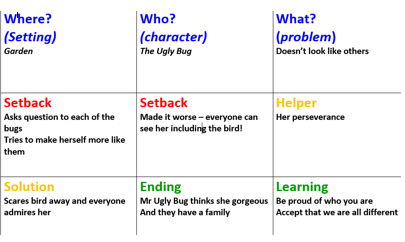
Later that day we talked about the plot of the story. We used the plot matrix to help us. 

After we wrote our own simple book review of the book.
We used these sentence starters.

I like the Ugly Bug story  because ………………………………….at the beginning/in the middle/in the end.
My favourite part of the story is the part where…………………………
I didn’t like the part where ……….
Ask your child these questions to find out what they liked about the book.  You may like to use these sentence starters when you read other books with them.
On Tuesday we used our imagination to draw our own ugly bugs just like a real illustrator.  Then we looked at the adjectives the author used to describe the Ugly Bug.

HUGE, boggly, eyes.
Odd, wibbly,wobbly shaped head.
Horrible, hairy back.
Wonky, purple legs
We noticed the author had used expanded noun phrases – adjective, comma, adjective noun. We then chose our best adjectives to describe our bugs eyes, head, body and legs just like a real author.
 On Wednesday we retold the story as a class and then got into groups of five to re-enact the story.  We had to remember to
·         Speak clearly and loudly
·         Look at audience
·         Use expression
·         Add actions and sound effects
·         Work together as a team

On Thursday we had great fun creating our own ugly bug models.  You will get a chance to see them next week when you come to the assembly.


You may want to read other stories with Ugly in the title and make comparisons between them.  The Ugly Duckling, The Ugly Five by Julia Donaldson.

Today we have been thinking about our assembly next week, and what we would each like to do. Children with a speaking part have brought their lines home today. Please can you practise these over the weekend so your child is ready for our first practice on Monday, thank you. 

Good news - both classes have achieved ten apples! We have both decided to have a Teddy Bears' picnic. Please can you send your child in to school on Friday with a small, named teddy and a snack to eat. The snacks will not be chilled. 

Have a great weekend! 

The Year Two Team

P.S. Can you spot the expanded noun phrases in our blog?