Friday, 7 February 2020

Friday 7th February 2020


This week in English we have continued to use the story On the Way Home.
On Monday we looked at a collection of words and realised they were all words from the story.


We looked at the word friend and talked about strategies to remember how to spell it.  Our most popular strategy was friend. We used the strategy ‘Look, cover, write, check’ to write the word.  After we played ‘Quick write’ where we had to see how many times we could write the word friend in our neatest writing in one minute.
We repeated the activities with the word there. Our most popular strategy was thereWe linked the place words here and there to help us remember how to spell there.
After we worked in pairs, choosing words from the list to spell.  We used the spelling strategy ‘Look, cover, write, check’  
All these words could be part of the children’s stories next week so you may like to let them practise at home.
On Tuesday we revisited our learning about exclamations.
The type of exclamations we were learning about were the ones that begin with a How or a What and end in an !
We used Jill Murphy’s example from the story ‘How dreadful!'
We then made up our own exclamations. 
We talked about where the ! goes.

What an astonishing story said Meg! Or What an astonishing story! Said Meg. 
Which is correct?

Talk to your children about the correct position and look out for exclamations in books.
On Wednesday in our SpAG lesson we revisited our learning about question sentences.
We thought about the recurring question in On the Way Home -  ‘How did you do it?’
We talked about these question words – Who  What  Where  When  Why
We worked in threes and took turns to pick up a question card  Who  What  Where  When  Why. Then we thought of a question sentence to go with that word. 

You may like to play this game at home.

On Thursday we thought of our favourite part from On the Way Home.  First we began by quickly drawing the key moment, showing the main character Claire, the character she imagined and how she got away. We added details to help us remember what happened. Next we wrote an expanded noun phrase describing the character Claire met. We remembered the rule – adjective, adjective, noun.  Then we thought of four verbs to describe what was happening in the picture.   After that we wrote a sentence using the expanded noun phrase and verbs.
  
Finally we wrote an exclamation. 
On Friday we planned our own On the Way Home stories using a plot matrix.You may like to tal
k to your child about the story they planned so they are ready to write it next week.


Spelling
This week in spelling we were learning about the suffixes – less, ly,  ily.
We made words suing the root word and the suffix.

On Tuesday we revisited our learning about the possessive apostrophe.
The children made up their own sentences
Mrs Roberson’s glasses.
Mrs Bootle’s blanket.
On Wednesday the children learnt a selection of new homophones.
no/know            knight/night                to/too/two
On Thursday our dictations were
The careless bus driver didn’t shut the door of the bus because he didn’t know he had to!

The playful child dropped his sister’s toy on the floor at night.

The children played happily for two weeks.


Please help your child practise these spelling rules at home.

In art this term we have been learning about the works of Claude Monet and Vincent Van Gogh.

We have learnt to paint in the style of these great artists. 

We have learnt about
·        -  the brush strokes they used
·         - the colours they used
·        -  how they liked to paint the same scenes at different times of day and in different seasons
·         - how they like to paint cityscapes and landscapes

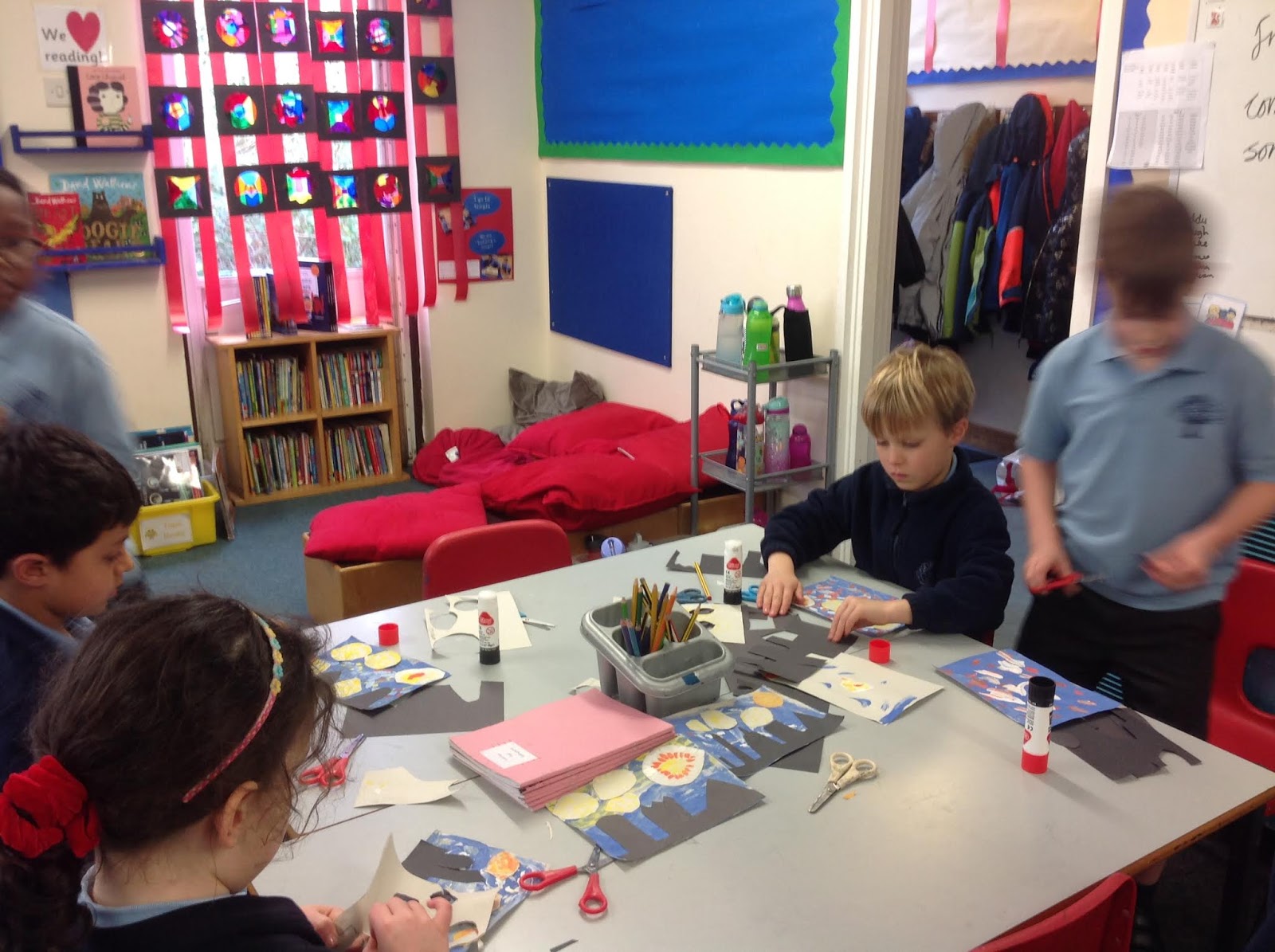
A couple of weeks ago we used Van Gogh’s ‘Starry Night’ painting to inspire our own paintings.  We painted the night sky using the same brush strokes and colours.
This week we turned our starry skies into cityscapes by cutting a night skyline of London.  We also cut out our moon and stars we had previously painted and added them to our work.
Look at our wonderful efforts. 


This week in maths we have been learning about shape. We started by looking a 3d shapes and used mathematical words to describe their properties. Shapes we described include: Cube, cuboid, cylinder, cone, sphere, pyramid and prism.
We named the shapes and counted their faces, edges and vertices.
Ask your child if they can explain the following words:
Faces – the flat 2d shapes on the surface of a 3d shape
Edges – where the faces meet
Vertices – where the edges meet

As you see shapes in the environment as your child to name them and count their faces, edges and vertices.

The next day we looked at 2d shapes. We named and described the shapes by counting their sides/edges and vertices. Ask your child if they can describe the following 2d shapes: circle, square, rectangle, triangle, pentagon, hexagon and octagon.

The next day we investigated the lines of symmetry on 2d shapes. We thought about where lines on symmetry might be and we used mirrors to check if we were correct. Here is a video we watched about lines of symmetry   that you might like to watch at home. https://www.bbc.co.uk/bitesize/clips/ztpyr82


On Friday we used a selection of shapes and sorted them in different ways. Our friends had to look at our shapes and try and work out the criterion we had used. Some of our ways of sorting them were:   
  • 2d or 3d shapes
  • < 4 vertices or > 4 vertices  
  • All equal length edges or not all equal length edges.


Next week we will be making our ‘geographical locations’ shoe boxes. Children can choose if they wish to create a town, city, village or coastal location. Please remember to send in a named, normal-sized shoe box, if you have not already done so.

We hope you have a good weekend – we can’t believe there is only one week left until half term!
The Year Two Teachers

Friday, 24 January 2020

Friday 24th January


This week in English we have been basing our writing on our visit to St.Albans Abbey. 
On Monday we revisited the story of Alban that we acted out at the Abbey.  We re-enacted the story again reminding ourselves of how Alban lived in the Roman town of Verulamium and met the Christian priest Amphibalus. After we wrote sentences about our favourite and least favourite parts of the story. Many of us chose the part where the executioner’s eyes popped out of his head as our favourite part! We used the word because to explain why we had chosen those particular events.
On Tuesday we had special words from the story of Alban that we had to write our own definitions for.
Here are some of the words – Christian, miracle, spring, Verulamium, St. Albans, Alban, Amphibalus, Roman emperor, Abbey.  Ask your child to explain what the words mean.
On Wednesday in our SpAG lesson we were revisiting our learning about co-ordinating conjuctions and, so but, or.


Can you child choose the best co-ordinating conjuction for these sentences?
We then wrote our own sentences using the conjuctions and,so, but, or.  Can you child make up their own sentences using these conjuctions?

On Thursday and Friday we used our collection of special words to help us write our own report about the story of Alban.
We had to make sure our report was written in the past tense, that we wrote statements that were true and use specific words.  We also had to use capital letters for names of people and places and see if we could include ! and ? when appropriate.


Spelling
In spelling this week we started the week learning about  suffixes (word endings).
We learnt the rule: Kick off the ‘e’ and add the suffix – this works with any of the suffixes below.
(ing, ed, er, est, y)
These are the words we applied the rule to - hike, shine, hope, take, write, make, like, ride
There are exceptions (quickly) e.g. make àmade, shine àshone, take àtook
The children then chose three root words and practised this strategy.
e.g. hike
à hiking        hike à hiked       hike à hiker
The following day we revisited our learning about contractions. Contractions are when two words are squashed together so tightly that one or more letters pop out and you put an apostrophe there instead.
Eg  could not becomes couldn’t
Our dictation was He was making a model but he couldn’t because he hadn’t got a tube.
Discuss the contractions in the sentence above.
On Wednesday the children learnt about homophones.  A homophone is a number of words that sound the same but have different meanings and are spelt differently.  This week we looked at the words:         bear/bare        flower/flour    hear/here
Talk to your child about the spelling and meanings of the words.
They then did the following  dictations.
The bear has bare legs!      The flower has beautiful petals.          I can hear the sea from here.
Our last dictations recapping the week’s learning were       Most hikers didn’t like riding their bikes with bare legs.
The sun likes shining but only when it’s Summer and there are lots of flowers.
Help your child over the weekend with any spellings they found tricky this week. Practise dictations at home as we will be having them regularly at school.
This is a good opportunity for your child to practise their joined handwriting too.
 Handwriting
This week we focused on the following letters and words.


 This week in maths, we have started our new topic of statistics. First, we remembered our learning about collecting information and recording it as a tally chart. Then we decided the topic and choices that we would include in our tally. We recorded this in our books and enjoyed asking our class their choices. We also asked and answered our own questions, using the data.


 Here are some examples of our work:


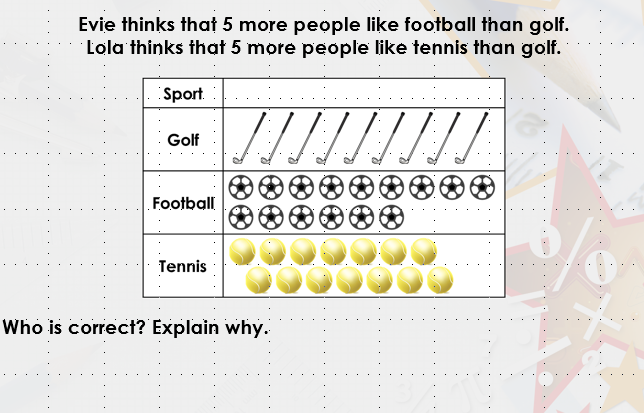
We have used data to create pictograms, where one symbol represents one count. We have used them to answer questions about the data. Here are some questions you could try at home: 


The next day we created pictograms and challenged ourselves to use a one picture to represent 2, 5 or 10 objects. Have a look at some of our work.


We have answered questions using pictograms, where one picture represents 2, 5 or 10 objects. Here are some you could try at home: 


We will be continuing our statistics learning next week when we will be making block graphs with scales of 2, 5 or 10 and answering questions about the graphs. 


We hope that you have a good weekend, 

The Year Two Team

PS Please remember to keep any shoes boxes you have , ready to bring into school at the beginning of February. 


Friday, 17 January 2020

Friday 17th January


Today we have enjoyed a visit to St Albans Cathedral and Abbey Church. We learnt about the life of St Albans and enjoyed a stained glass workshop. Thank you very much to all the parents who came with us, we really appreciate your support and hope you enjoyed the day. 


This week in English we continued learning about different types words.
On Monday we focused on adverbs ( a word that describes the verb)
We used our list of verbs from Friday and thought of the best adjectives to describe them.  We then wrote our own sentences that included an adverb.
Can your child think of the best adjective to describe the following verbs: whispered, shouted, cried, hopped, walked.
You could play the game Ping Pong at home where the first person says a verb and the other person says the best adverb to describe the verb.
On Tuesday we played the corners game.  Each corner of the classroom was given a word - adjective, adverb, noun and adverb.  The teacher then called out a word and the children went to that corner.  Here are some words we used: golden, quickly, cat, house, jump, brown, huge, loudly, listen, clap.
We then went on a treasure hunt with a partner to consolidate all our learning over the last 2 weeks.
Here are some of the questions.


On Thursday where we had similar questions to the ones above but we worked on our own.
When reading at home ask your child multiple  choice type questions like these to embed their learning.
Spelling
In spelling this week we started the week revisiting an alternative phoneme for the ie sound.  The words we read were by,  cry, dry, sky, July, try, why, reply. The children then chose four words to spell using the look, cover, write, check strategy.  You will see  these in their spelling journal.
They then did the dictation  Don’t cry in July because soon time will fly by.
The following day we learnt about contractions. Contractions are when two words are squashed together so tightly that one or more letters pop out and you put an apostrophe there instead.  Eg do not becomes don’t
The children wrote down the contractions we talked about. 
They then did the dictation  I can’t wait for Sunday because it’s my birthday and I’ll be seven.
Discuss the contractions in the sentence above. You may also like to look for contractions when reading. How many can you find?  Which is most common?
On Wednesday the children learnt about homophones.  A homophone is a number of words that sound the same but have different meanings and are spelt differently.  This week we looked at the words:         sea/ see                           be/bee                               blue/blew
Talk to your child about the spelling and meanings of the words.
They then did the following  dictations.  I can see the sea?    Can you see me?  Don’t be afraid to the bee.  The wind blew.  Blue is my favourite colour.
Help your child over the weekend with any spellings they found tricky this week. Practise dictations at home as we will be having them regularly at school.
This is a good opportunity for your child to practise their joined handwriting.
 Handwriting
This week we focused on the following letters and words.


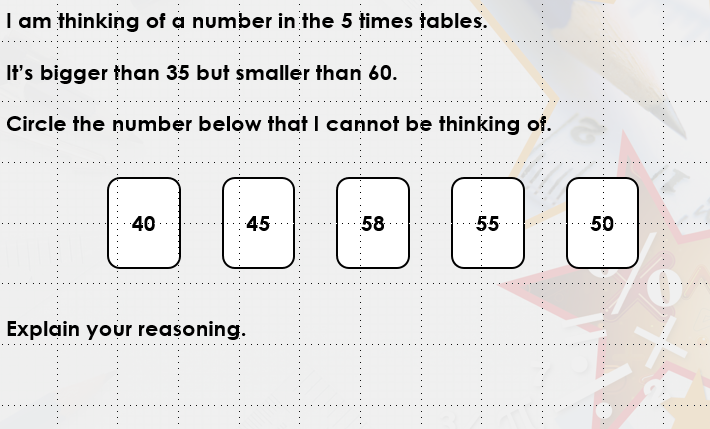
In maths we have been continuing our learning about multiplication and division. This week we have focused on the two and five times tables. Here are some examples of questions we have investigated. Please try some of these at home. 


 We hope you have good weekend! 

Year Two Team